

First Sentences
280 Words
Marie Curie was a woman.
She lived a long time ago.
She was very smart.
She worked with science.
She helped many people.
Marie was born in 1867.
She was born in Poland.
Her name was Maria when she was a girl.
Her family was poor.
Her parents worked at a school.
Marie liked books.
She liked to read.
She loved to learn.
She wanted to study science.
In Poland, many girls could not go to school.
Marie studied at home.
She read every day.
She worked very hard.
She did not stop.
Marie went to France.
She went alone.
She had little money.
She lived in a small room.
She was often cold and hungry.
She went to a big school in France.
She studied science and math.
She was a very good student.
Marie met a man named Pierre.
Pierre was a scientist.
They liked science.
They got married.
Her name became Marie Curie.
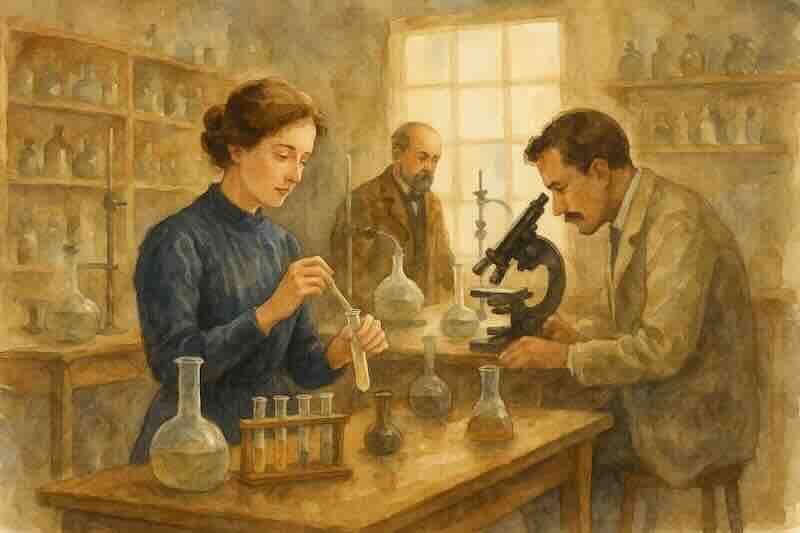
Marie and Pierre worked together.
They studied rocks.
The rocks had energy.
Marie called this energy “radioactivity.”
They found two new things.
The things were very small.
The things were very strong.
Marie won a big science prize.
The prize was called the Nobel Prize.
She was the first woman to win it.
She won the prize two times.
She did not stop working.
She wanted to help sick people.
She used science to help doctors.
She helped people in a big war.
She taught other women.
Marie worked for many years.
She became sick later in life.
She died in 1934.
People remember Marie Curie today.
She is famous around the world.
She showed that women can be scientists.
Marie Curie helped the world.
Level 1 Reader
600 Words
Marie Curie: A Woman of Science
Marie Curie was a very smart woman. She lived a long time ago. She helped many people. She worked with science. She found new things. Her work changed the world.
A Girl from Poland
Marie Curie was born in 1867. She was born in a country called Poland. Her name was Maria when she was a girl. Her family was poor, but they were smart. Her father was a teacher. Her mother worked at a school. Marie liked to read books. She loved to learn. She wanted to go to school and study science.
But in Poland, girls could not go to some schools. So, Marie had to study in secret. She worked hard. She read books every day. She did not give up.
A Trip to France
Marie wanted to learn more. She wanted to go to a big school. So, she left Poland. She went to France. She was very young and alone. It was hard. She had little money. She lived in a small room. She was cold and hungry. But she was happy. She could learn science at a big school.
In France, people called her “Marie.” She studied math, science, and chemistry. She worked very hard. She was the best student in her class.
A Man Named Pierre
Marie met a man. His name was Pierre Curie. He was a scientist too. They liked each other. They talked about science. They got married. Now her name was Marie Curie.
Marie and Pierre worked together. They looked at rocks and metals. They studied strange things in the rocks. These things gave off energy. The energy came out slowly. Marie gave this energy a name. She called it “radioactivity.”
A Big Discovery
Marie and Pierre found two new things. These things were not in books before. They called them polonium and radium. No one had found them before. These things were very small. They were very strong. They were full of energy.
Marie wrote many papers. She told people about her work. Other scientists read her work. They were surprised. She became very famous.
A Big Prize
In 1903, Marie and Pierre won a big prize. It was called the Nobel Prize. It is the biggest prize for science. Marie was the first woman to win it.
Later, in 1911, Marie won another Nobel Prize. She was the first person to win the prize two times. She was very happy. But she did not stop working. She wanted to help people.
Helping People
Marie Curie wanted to use science to help sick people. She used radium to treat people with cancer. It was a new idea. It helped many people feel better.
During a big war, she helped doctors. She made small machines. These machines helped doctors see inside the body. Marie drove a car to take the machines to many places. She taught other women how to use the machines.
A Hard Life
Marie’s life was not easy. She worked very hard. Her husband Pierre died in an accident. Marie was very sad, but she kept working.
She also got sick. The energy from her work made her sick. But no one knew it was dangerous at that time. Marie worked until she was very old.
A Great Woman
Marie Curie died in 1934. She was 66 years old. Today, people still remember her. She is in history books. Schools, hospitals, and streets are named after her. She showed that women can be great scientists. She helped the world with her ideas.
Marie Curie is a hero of science.
Level 2 Reader
484 Words
Marie Curie: A Life of Discovery
Marie Curie was a scientist. She was the first woman to win a Nobel Prize—and the only person to win in two different sciences: physics and chemistry. Her work changed the world.
A Young Girl from Poland
Marie Curie was born in Warsaw, Poland, in 1867. Her real name was Maria Sklodowska. Her family loved learning, and both her parents were teachers. But life was hard. Her mother died when Marie was only ten years old, and her father lost his job.
At that time, women in Poland could not go to university. But Marie wanted to study science. She decided to go to France.
Studying in Paris
In 1891, Marie moved to Paris. She changed her name to Marie. She studied at the Sorbonne, a famous university. Life in Paris was not easy. She had very little money. She lived in a cold room and often ate only bread and tea. But she studied hard and became one of the best students in her class.
A Scientific Team
In Paris, Marie met a scientist named Pierre Curie. They married in 1895 and began working together. They studied a strange kind of energy that came from special rocks. This energy was later called “radioactivity.”
Marie and Pierre discovered two new elements. They named them polonium (after Marie’s country, Poland) and radium. These discoveries were very important for science and medicine.
A Big Prize
In 1903, Marie and Pierre won the Nobel Prize in Physics, along with another scientist named Henri Becquerel. Marie was the first woman to win a Nobel Prize.
But in 1906, something terrible happened. Pierre died in an accident. Marie was very sad, but she continued their work. In 1911, she won another Nobel Prize—this time in Chemistry—for her discovery of radium and polonium. She was the first person to win two Nobel Prizes.
Helping During War
During World War I, Marie wanted to help. She made small machines that used X-rays to see inside the human body. These machines helped doctors find bullets and broken bones in soldiers. She also trained women to use them. These machines saved many lives.
A Difficult Ending
Marie Curie worked with dangerous materials. At that time, people did not understand how harmful radiation could be. Marie became sick because of the radioactive materials she used in her work. In 1934, she died from an illness caused by radiation.
A Legacy of Science
Marie Curie’s work helped create new ways to treat cancer. She opened the door for many women in science. Today, many people still look up to her as a role model. Her name is remembered in schools, hospitals, and science centers around the world.
She once said, “Nothing in life is to be feared. It is only to be understood.” Marie Curie’s life shows the power of learning, courage, and hard work.
Level 3 Reader
644 Words
Marie Curie: A Life of Science and Sacrifice
When people think of great scientists, Marie Curie is often one of the first names that comes to mind. She was not only the first woman to win a Nobel Prize, but also the first person to win two Nobel Prizes in two different scientific fields. Her life was filled with discovery, hardship, and an unwavering dedication to science.
Early Life in Poland
Marie Curie was born in 1867 in Warsaw, Poland. Her birth name was Maria Sklodowska. She grew up in a family that valued education, even though women at that time were not allowed to attend university in Poland. Her father was a teacher of mathematics and physics, and he encouraged Marie to learn as much as she could.
After finishing school, Marie dreamed of becoming a scientist, but there were no opportunities for women to study science at a high level in her country. Determined to continue her education, she moved to Paris in 1891 and changed her name to Marie. There, she attended the Sorbonne, one of the most prestigious universities in Europe. It was not easy—she was poor, cold, and hungry most of the time—but she never gave up.
Discovering Radioactivity
In Paris, Marie met Pierre Curie, a scientist who shared her passion for research. They married in 1895 and began working together. In 1898, the Curies discovered two new elements: polonium (named after Marie’s beloved homeland, Poland) and radium. Their research helped develop the concept of radioactivity, a term that Marie herself coined.
Their discoveries were revolutionary. At the time, scientists did not fully understand that atoms could break apart and release energy. Marie and Pierre’s work changed that. For their groundbreaking achievements, they shared the Nobel Prize in Physics in 1903 with another scientist, Henri Becquerel.
A Woman in a Man’s World
Marie Curie’s success was extraordinary, especially because she lived in a time when women were not considered equal to men in science or in society. Even after winning her first Nobel Prize, some people believed that Pierre had done most of the work. But Pierre himself always said that Marie was the driving force behind their discoveries.
When Pierre died in a tragic accident in 1906, many assumed that Marie would stop her research. Instead, she took his position at the university and became the first female professor at the Sorbonne. She continued their work and, in 1911, won a second Nobel Prize—this time in Chemistry—for her discovery of the pure form of radium.
A Life of Sacrifice
Marie Curie’s dedication to science came at a cost. She worked with radioactive materials before people fully understood the dangers. She did not use protective equipment, and as a result, her health suffered greatly. Many years later, it became clear that her constant exposure to radiation had caused the illness that eventually killed her in 1934.
Despite these risks, Marie never stopped working. During World War I, she helped develop mobile X-ray units that were used to treat injured soldiers. She trained nurses and even drove the vehicles herself. She believed that science should serve humanity.
A Lasting Legacy
Marie Curie’s legacy lives on today. Her work laid the foundation for modern physics and medicine, including cancer treatments that use radiation. She broke barriers for women in science and proved that determination and intellect are more important than gender or background.
Her notebooks are still kept in lead-lined boxes because they are too radioactive to be handled safely. Yet, her ideas and influence continue to inspire scientists around the world.
Marie Curie was not just a scientist—she was a pioneer, a teacher, a mother, and a symbol of strength. Her life reminds us that even in the face of great challenges, it is possible to change the world through curiosity, courage, and commitment.
Extensive Listening
First Sentences
Level 1 Audio
Level 2 Audio
Level 3 Audio
Natural Overview 1
Natural Overview 2
Natural Discussion
Audio is AI-generated using
AWS Polly or Google NotebookLM
Check Your Understanding
Comprehension Activity
A) In the article or B) Not in the article.