

First Sentences
336 Words
The Apollo Program was a space program.
It was in the United States.
NASA made the program.
NASA is a space group.
The goal was to go to the Moon.
This was a long time ago.
It was in the 1960s.
It was also in the 1970s.
Many people worked on it.
They worked very hard.
They built big rockets.
The U.S. wanted to go to space first.
Another country also wanted to go first.
It was called the Space Race.
The U.S. said, “We will go to the Moon.”
The president said this in 1961.
His name was John F. Kennedy.
It was a big dream.
People worked hard for this dream.
NASA tested many rockets.
Some rockets went into space.
Some rockets went around the Moon.
The rockets were very big.
One rocket was called Saturn V.
It was very tall.
Apollo 11 went to the Moon.
This was in 1969.
Three men went on this trip.
Their names were Neil Armstrong, Buzz Aldrin, and Michael Collins.
Michael stayed in the ship.
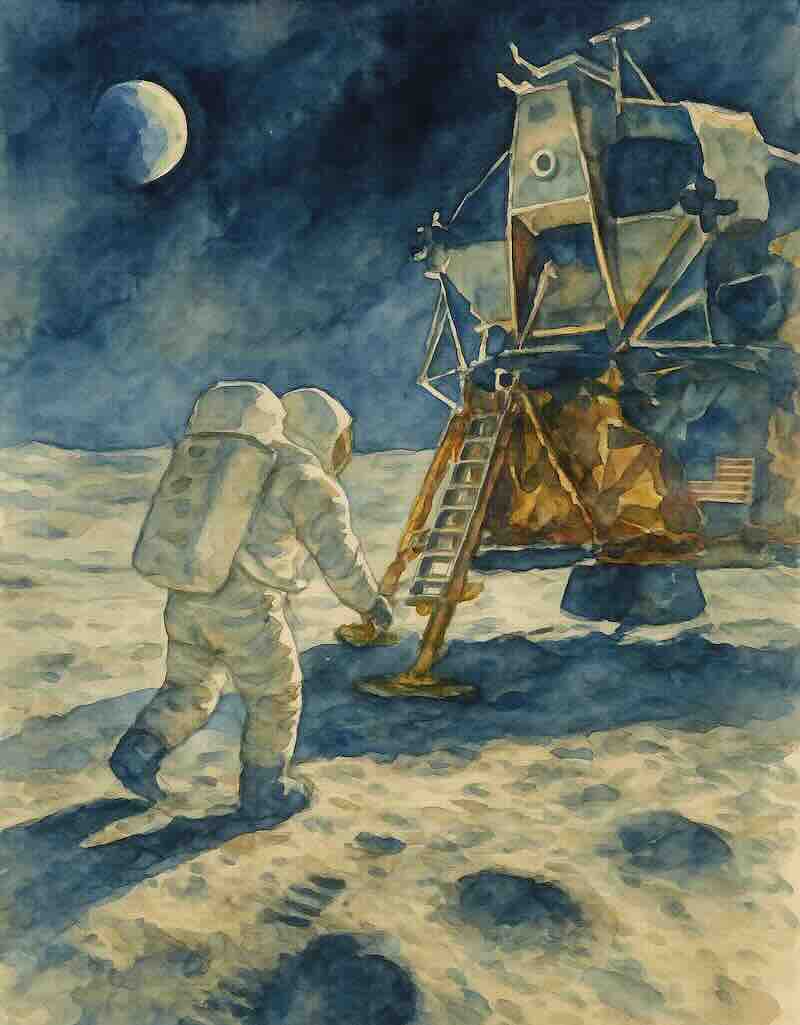
Neil and Buzz went down to the Moon.
Neil walked first.
He walked on the Moon.
Buzz walked after him.
They stayed for about two hours.
They picked up rocks.
They took pictures.
Then they came back to Earth.
Many people watched on TV.
People were very happy.
Other Apollo trips went to the Moon.
Apollo 13 had a problem.
But the men came home safe.
In total, 12 people walked on the Moon.
The Moon has no air.
Astronauts wore special suits.
The suits gave them air.
They moved slowly on the Moon.
The Moon has weak gravity.
The last Apollo trip was in 1972.
After that, people did not go back to the Moon.
But we learned many things.
We learned about space.
Today, people want to go back to the Moon.
NASA has a new plan.
It is called Artemis.
Maybe people will live on the Moon one day.
The Apollo Program showed that dreams can come true.
Level 1 Reader
545 Words
What Is the Apollo Program?
The Apollo Program was a space program. It was made by NASA, the space agency in the United States. The goal was to send people to the Moon. This happened a long time ago, in the 1960s and 1970s. Many people worked on the Apollo Program. They were scientists, engineers, and astronauts. It was a big job. It took many years.
Why Go to the Moon?
In the 1960s, the U.S. and the U.S.S.R. wanted to be first in space. It was called the “Space Race.” The U.S. said, “We will go to the Moon!” President John F. Kennedy said this in 1961. He said, “We choose to go to the Moon.” It was a very big dream. But America worked hard to make it come true.
The First Steps
Before going to the Moon, NASA tested many rockets. The first missions were Apollo 1, Apollo 7, and Apollo 8. Apollo 8 went around the Moon. But no one walked on the Moon yet. The rockets had names like Saturn I and Saturn V. Saturn V was very big. It was the rocket that went to the Moon.
Apollo 11
Apollo 11 was the first mission to land on the Moon. It was in 1969. Three astronauts went: – Neil Armstrong – Buzz Aldrin – Michael Collins. Michael stayed in the ship in space. Neil and Buzz went down to the Moon. Neil Armstrong walked first. He said, “That’s one small step for man, one giant leap for mankind.” Buzz walked after him. They stayed on the Moon for 2 hours. They picked up rocks and took pictures. Then they came back to Earth. Many people watched it on TV. It was a very happy time.
Other Apollo Missions
After Apollo 11, there were more trips to the Moon. Apollo 12 also landed on the Moon. Apollo 13 had a big problem, but the astronauts came home safe. Apollo 14, 15, 16, and 17 also went to the Moon. In total, 12 people walked on the Moon. They did science. They brought back Moon rocks. They showed the world that space travel is possible.
Life in Space
Astronauts wore special suits. The Moon has no air. The suits gave them oxygen. They ate special food in space. They had to be very careful. There is weak gravity on the Moon. So they moved slowly and carefully.
After the Moon
After Apollo 17 in 1972, people did not go back to the Moon. NASA stopped the Apollo Program. But the program helped science grow. We learned about the Moon. We learned how to live and work in space. Later, people made the Space Shuttle and the Space Station. Now, many countries work together in space.
A New Future
Today, people want to go back to the Moon. NASA has a new plan. It is called the Artemis Program. They want to send the first woman and the next man to the Moon. Maybe one day, people will live on the Moon. Maybe we will go to Mars. The Apollo Program showed that big dreams can come true. It started with one small step.
Level 2 Reader
588 Words
A Dream to Go to the Moon
In the 1960s, the United States and the Soviet Union were in a space race. Both countries wanted to be the first to land a person on the moon. The United States started a program called the Apollo Program. The goal was simple but difficult: send people to the moon and bring them back safely.
President John F. Kennedy said in 1961, “We choose to go to the moon.” This speech gave hope and energy to many people. Scientists and engineers began to work hard. They had many problems to solve. They had to build strong rockets, keep astronauts safe, and learn how to land on the moon.
Building the Rockets
NASA, the American space agency, built a rocket called the Saturn V. It was the biggest rocket in history. It was more than 110 meters tall! The rocket had several parts, or stages. Each stage helped push the rocket higher into space. When one stage finished, it would fall off, and the next stage would begin.
The astronauts traveled in a special part at the top called the command module. There was also a lunar module, which could land on the moon and return to the command module in space.
Apollo 11 – The First Moon Landing
On July 16, 1969, Apollo 11 launched from Kennedy Space Center in Florida. There were three astronauts: Neil Armstrong, Buzz Aldrin, and Michael Collins.
After four days in space, they reached the moon. Michael Collins stayed in the command module. Armstrong and Aldrin went into the lunar module, called Eagle. The Eagle landed on the moon on July 20, 1969.
Armstrong went down the ladder and stepped onto the moon. He said the famous words:
“That’s one small step for man, one giant leap for mankind.”
Life on the Moon
Armstrong and Aldrin spent about 21 hours on the moon. They walked, took pictures, and collected moon rocks. They also put a flag on the surface and left a sign that said, “We came in peace for all mankind.”
Back on Earth, millions of people watched on TV. It was the first time humans had walked on another world.
After finishing their work, they returned to the lunar module, took off, and joined Collins in the command module. All three astronauts came back to Earth safely on July 24.
More Apollo Missions
After Apollo 11, there were six more Apollo missions that went to the moon. Astronauts continued to explore, learn, and bring back moon samples. One mission, Apollo 13, had a serious problem. An explosion damaged the ship. The astronauts could not land on the moon, but they worked with NASA to come home safely. It became a story of teamwork and courage.
The last moon mission was Apollo 17 in 1972. After that, no humans have gone back to the moon — yet.
Why the Apollo Program Was Important
The Apollo Program showed that people could travel to space and return safely. It helped science, technology, and even everyday tools. For example, space research led to better computers and stronger materials. It also gave people around the world a sense of hope and adventure.
Many people still remember the moon landing. It was a moment when the world came together to celebrate something amazing.
Now, new missions like Artemis are planning to go back to the moon — and even to Mars.
The journey is not over. It is just beginning again.
Level 3 Reader
565 Words
A Bold Dream
In the early 1960s, the United States and the Soviet Union were competing in what became known as the Space Race. Both countries wanted to prove their technological superiority by being the first to achieve major milestones in space exploration.
In 1961, President John F. Kennedy made a bold promise: the United States would send a man to the Moon and bring him safely back to Earth before the end of the decade. It was an ambitious goal, considering that humans had only just begun to explore space. This promise marked the beginning of the Apollo Program, a massive effort by NASA (the National Aeronautics and Space Administration).
Preparation and Tragedy
The Apollo Program was not just about rockets. It involved thousands of scientists, engineers, technicians, and astronauts working together. New technologies had to be invented, and existing ones had to be improved.
However, the journey was not without setbacks. In 1967, tragedy struck. During a pre-flight test for Apollo 1, a fire broke out in the spacecraft, killing all three astronauts inside. The accident shocked the nation and caused NASA to delay future missions to make safety improvements. Despite this terrible event, the program continued, stronger and more careful than before.
Stepping Stones to the Moon
Before astronauts could land on the Moon, NASA had to test every part of the mission. Apollo 7 was the first successful manned test flight of the command module in Earth orbit. Then, Apollo 8 became the first mission to take astronauts around the Moon and return safely. These missions were important milestones that gave NASA the confidence to move forward.
Apollo 10 was a “dress rehearsal” for the Moon landing. The astronauts came within 15 kilometers of the lunar surface but did not land. Every step brought them closer to their final goal.
One Giant Leap
On July 16, 1969, Apollo 11 launched from Kennedy Space Center in Florida. Aboard the spacecraft were three astronauts: Neil Armstrong, Buzz Aldrin, and Michael Collins. Four days later, Armstrong and Aldrin entered the lunar module, Eagle, and descended to the Moon’s surface.
On July 20, Armstrong became the first human to walk on the Moon. His famous words — “That’s one small step for a man, one giant leap for mankind” — were broadcast to millions of people on Earth. Aldrin soon joined him. They spent about two and a half hours walking on the Moon, collecting samples, and conducting experiments. Meanwhile, Collins remained in orbit, piloting the command module.
A Legacy for the Future
In total, NASA launched 17 Apollo missions, and 12 astronauts walked on the Moon between 1969 and 1972. The program ended with Apollo 17, but its impact lasted much longer.
The Apollo Program changed how humanity saw itself. For the first time, people had left their home planet and explored another world. The missions led to advances in computer technology, engineering, and science that still benefit us today.
Though no human has walked on the Moon since 1972, interest in lunar exploration is growing again. NASA’s new Artemis Program aims to return humans to the Moon — and this time, to stay longer and go farther.
The Apollo Program was not just a mission to the Moon. It was a symbol of what people can achieve when they dare to dream big and work together.
Extensive Listening
First Sentences
Level 1 Audio
Level 2 Audio
Level 3 Audio
Natural Overview 1
Natural Overview 2
Natural Discussion
Audio is AI-generated using
AWS Polly or Google NotebookLM
Check Your Understanding
Comprehension Activity
A) In the article or B) Not in the article.