

Still Life Game
[Any Language]
The Still Life Builder is a simple tool for practicing prepositions of location, spatial vocabulary, and giving and receiving instructions in any second or foreign language.
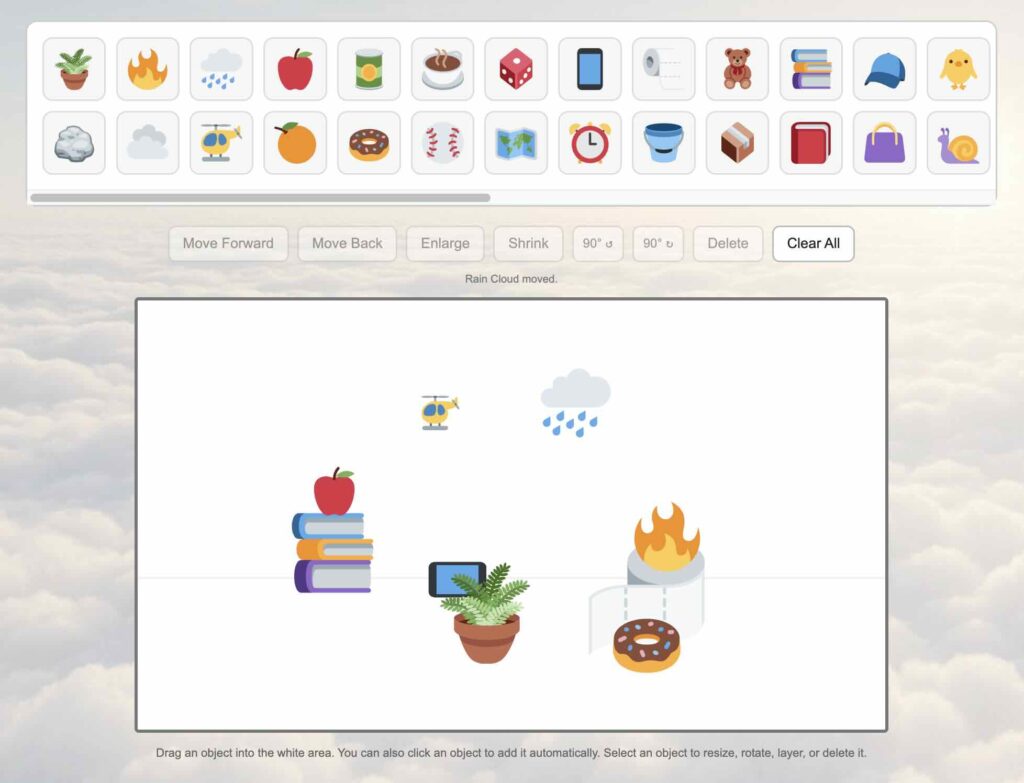
Students can arrange emoji objects inside the white area by dragging them from the object tray or clicking them to add them. Once an object has been added, it can be moved, made bigger or smaller, rotated, moved in front of or behind another object, or deleted.
The Basic Activity
Students work in pairs or small groups.
One student is the builder. The builder controls the Still Life Builder but should not see the target arrangement.
Another student, or the other members of the group, can see an image of the arrangement and must explain where all of the objects belong using only the target language.
For example:
- Put the apple next to the books.
- Move the coffee to the right of the plant.
- Put the teddy bear between the box and the apple.
- Place the phone under the book.
- Move the baseball a little closer to the box.
- Put the newspaper behind the coffee.
- Make the plant a little bigger.
- Turn the shoe 90 degrees to the left.
The builder should also communicate. Students should ask questions, confirm instructions, and negotiate meaning until they understand exactly where each object should go.
For example:
- Like this?
- Do you mean the left or the right?
- How close?
- Which object?
- A little farther?
- Should it be in front of the box or behind it?
- Is this the right place?
- Do you mean the big book or the small book?
Everyone should use the target language throughout the activity.
Compare the Results
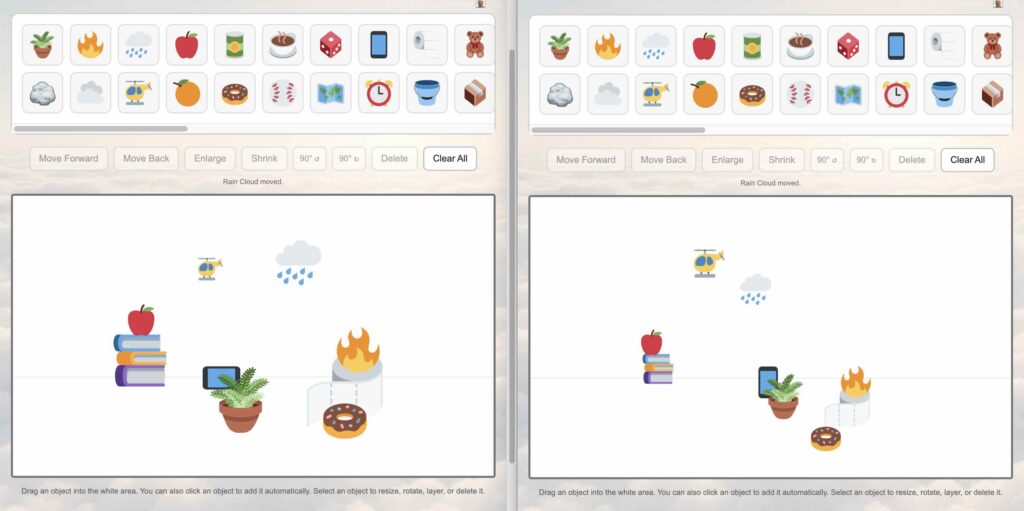
When the arrangement is finished, reveal the original image and compare the two.
How similar are they?
Students can then discuss the differences using the target language:
- The apple is too far to the left.
- The book should be closer to the plant.
- Our teddy bear is bigger.
- The phone is in front of the newspaper, but it should be behind it.
- The cup needs to move a little higher.
Students can switch roles and try another arrangement so that everyone has an opportunity to give and receive instructions.
Make Your Own Still Life
Teachers do not need to prepare all of the arrangements.
One student can create a still life using any of the available objects and then take a screenshot of it. Another student or group can try to recreate it from spoken instructions.
Students can also design deliberately difficult or funny arrangements for other groups to reproduce.
Who can create the most challenging still life?
Who can give the clearest instructions?
Which group can produce the most accurate copy?
Practice Prepositions of Location
The activity is especially useful for practicing language related to spatial relationships, including equivalents of:
Basic Position
on, in, inside, under, underneath, above, below, over
Left and Right
to the left of, to the right of, on the left, on the right
Distance
near, far from, next to, beside, close to, closer to, farther from
Relative Position
between, in the middle of, in front of, behind
Contact and Arrangement
touching, against, overlapping, at the edge of, in the corner, in the center
Direction and Adjustment
higher, lower, up, down, left, right, clockwise, counterclockwise, slightly, a little, exactly
Teachers can choose the vocabulary and grammatical structures appropriate for the students’ proficiency level and the target language.
Practice Giving Instructions
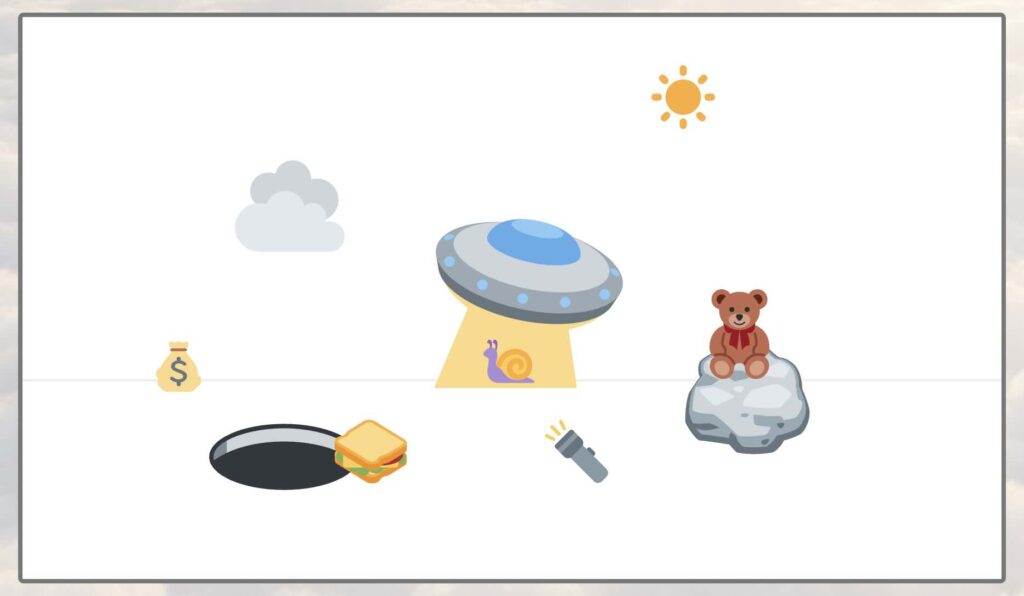
The activity can also provide repeated, meaningful practice with instructional language:
- First…
- Next…
- Then…
- Move…
- Put…
- Place…
- Turn…
- Make it bigger.
- Make it smaller.
- Move it a little to the left.
- Put it behind the other object.
- Bring it forward.
- Turn it 90 degrees.
For beginner students, teachers can provide a small set of required expressions.
More advanced students can be encouraged to give increasingly precise instructions without pointing, gesturing, or switching languages.
Practice Polite Language
Instead of simply saying:
Move the apple.
students can practice socially appropriate ways of making requests:
- Please move the apple.
- Can you move the apple a little?
- Could you put it next to the book?
- Could you move it slightly to the right, please?
- Would you mind putting it behind the box?
- Maybe you could move it a little closer.
The teacher can require different levels of politeness depending on the lesson.
Negotiate Meaning
One of the most useful parts of the activity is that communication will not always work perfectly.
That is a good thing.
When an instruction is unclear, students have a genuine reason to ask for clarification, repeat themselves, rephrase an idea, confirm their understanding, or correct a misunderstanding.
Students might need expressions such as:
- What do you mean?
- Which one?
- Where exactly?
- Could you say that again?
- Do you mean this one?
- Do you mean here?
- How far?
- Can you explain it another way?
- Almost?
- Is that right?
- Yes, exactly!
- No, a little farther.
- That’s perfect.
This kind of negotiation of meaning is an important part of real communication in another language.
Other Ways to Use the Tool
With a little creativity, the Still Life Builder can support many other language-learning activities.
Students can practice describing a scene, following directions, giving commands, asking questions, comparing two images, using comparative language, describing differences, learning vocabulary, practicing numbers and quantities, telling stories, or working together to solve a problem.
For example, one student could create a strange scene and another student could invent a story explaining it. Students could listen to a teacher’s description and build what they hear. Two groups could receive the same instructions and compare their final arrangements. Advanced students could even give deliberately incomplete instructions and require their partners to ask good clarification questions.
The tool itself is simple. The communication around it can be as simple or as challenging as the teacher wants.
Use the target language as much as possible, communicate carefully, and have fun!