

Level 1 Reader
758 Words
The Amontillado Wine
Long ago, in Italy, there lived a man named Montresor. He was quiet and serious. He did not forget things. He did not forgive easily.
There was another man in the city. His name was Fortunato. Many people liked him. He liked to laugh. He liked parties. He liked to drink wine. He believed he knew a lot about wine.
Montresor did not like Fortunato.
Fortunato had said bad things to him many times. He had laughed at him in front of other people. Montresor felt angry in his heart. But he did not show his anger. He smiled when he saw Fortunato. He spoke kindly to him.
Inside, he wanted revenge.
One night there was a big party in the city. People wore masks and bright clothes. They danced in the streets. They sang and drank. Music was everywhere.
Montresor saw Fortunato during the party.
Fortunato wore a funny costume. He looked like a clown. He had a colorful suit and a hat with small bells. The bells made a soft sound when he moved. He was already drunk.
“My friend!” Fortunato said happily. “What a good night!”
“My friend,” Montresor said with a smile. “I am happy to see you. I need your help.”
“My help?” Fortunato asked.
“Yes,” Montresor said. “Today I bought a barrel of wine. The seller said it is Amontillado. But I am not sure.”
“Amontillado?” Fortunato said. “During the party? That is strange.”
“I think maybe I made a mistake,” Montresor said. “I will ask Luchesi to taste it.”
“Luchesi?” Fortunato laughed. “Luchesi does not understand wine. I will taste it.”
Montresor looked worried. “You have a cough. The air in my cellar is cold.”
“It is nothing,” Fortunato said. “I want to taste the wine.”
“Very well,” Montresor said.
They walked together to Montresor’s house. The streets were loud and bright. But soon they were inside the dark house.
“My servants are not here,” Montresor said. “They are enjoying the party.”
He took two torches from the wall. He gave one to Fortunato.
“Come with me,” he said.
They walked down a long stone staircase. The air became cold. The walls were wet. It was very quiet.
Fortunato coughed.
“We can go back,” Montresor said. “Your health is important.”
“No,” Fortunato said. “The Amontillado.”
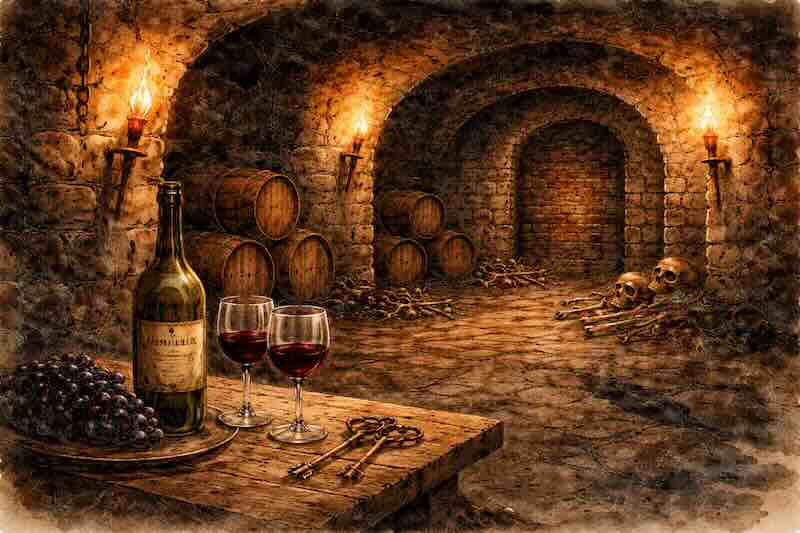
They walked deeper under the house. There were many bottles and barrels of wine. There were also piles of old bones near the walls. These were from Montresor’s family long ago.
Fortunato looked around.
“This place is old,” he said.
“Yes,” Montresor answered.
Fortunato coughed again.
Montresor gave him a bottle of wine.
“Drink this,” he said. “It will help.”
Fortunato drank and laughed. The bells on his hat rang again.
They walked farther and farther. The tunnel became smaller. The ceiling was low. The air was heavy.
At last they came to a small dark space in the wall.
“The Amontillado is inside,” Montresor said.
Fortunato stepped into the small space. It was narrow. There was a stone wall at the back.
He turned around to speak.
But before he could move, Montresor acted quickly.
He put chains around Fortunato’s body. The chains were already on the wall. He locked them.
Fortunato was very surprised.
“What are you doing?” he asked.
Montresor did not answer.
He picked up stones and cement from the ground.
He began to build a wall.
Stone by stone.
At first, Fortunato laughed.
“This is a joke!” he said. “A good joke for the party!”
Montresor continued working.
The wall became higher.
Fortunato pulled at the chains. They did not break.
“Montresor?” he said. “Stop this joke.”
Montresor kept building.
The wall reached Fortunato’s chest.
Fortunato began to shout.
His voice echoed in the tunnel.
Montresor stopped and listened.
Then he shouted back, louder than Fortunato.
After some time, Fortunato became tired. His voice became weak.
The wall became higher and higher.
Only a small opening was left.
“For the love of God, Montresor!” Fortunato cried.
“Yes,” Montresor said quietly. “For the love of God.”
He placed the last stone in the wall.
He covered it with cement.
The wall was complete.
Montresor stood still.
He listened.
There was no sound.
He put the old bones back in front of the wall. No one could see the new stones.
Then he left the cellar.
Many years passed.
No one found Fortunato.
No one knew what happened that night.
Montresor never told anyone.
He did not feel sorry.
He remembered the insult.
And he remembered the silence.
Rest in peace, Fortunato.
Level 2 Reader
994 Words
The Amontillado Wine
I have suffered many insults from Fortunato, but when he finally crossed the line, I decided that I would take revenge. I did not threaten him. I did not show anger. A wrong is not repaired when the punishment harms the one who gives it. It must be done carefully, without risk. The person who is punished must also understand who has punished him.
Fortunato had a weakness. He believed he was an expert in wine. He could speak for hours about the quality of a drink, its age, its country, and its price. Many people respected his opinion. I knew this pride would be useful.
During the carnival season, the city was full of noise and excitement. People wore masks and bright costumes. Music filled the streets, and no one paid much attention to anything serious. It was the perfect time.
I met Fortunato late in the evening. He had already been drinking. He wore a colorful costume, and small bells hung from his hat. They rang each time he moved. His face was red, and his eyes were bright.
“My dear Montresor!” he cried. “What good luck to meet you tonight!”
“My dear friend,” I answered warmly, hiding my true thoughts. “You are just the man I hoped to see. I have purchased a barrel of what is said to be Amontillado, but I have my doubts.”
“Amontillado?” he said with surprise. “Impossible! And during carnival?”
“I also think it strange,” I replied. “I was foolish enough to pay the full price without asking your advice. I was on my way to find Luchesi.”
“Luchesi!” Fortunato said sharply. “Luchesi cannot tell Amontillado from common wine.”
“I know,” I said calmly. “But some people say his judgment is equal to yours.”
Fortunato’s pride was touched. “Come,” he said. “We will go at once.”
I pretended to hesitate. “My friend, you have a bad cough. The air in my cellars is damp and cold.”
“It is nothing,” he answered. “A cough will not kill me. Let us go.”
I smiled. He had made the choice himself.
We walked through the crowded streets and soon reached my house. As I expected, my servants were gone. I had told them I would not return until morning, which guaranteed their absence. We took torches and began to descend into the underground vaults beneath my home.
The stairs were long and narrow. The air grew colder as we went down. The walls were covered with a white substance that shone in the torchlight.
Fortunato coughed loudly.
“The damp is heavy here,” I said. “We should turn back.”
“No,” he insisted. “The Amontillado.”
We continued walking through a series of dark rooms filled with barrels and bottles of wine. The ground was uneven. In some places, piles of bones were stacked against the walls. These were the remains of my family’s dead, who had been buried here for generations.
Fortunato drank from a bottle I gave him, hoping to warm himself. He laughed loudly, and the bells on his hat rang again.
“To your long life,” he said, raising the bottle.
“And to your health,” I replied.
As we walked deeper, the space became narrower. The ceiling was low, and the walls were wet. Fortunato’s cough grew worse, but he refused to return.
At last, we reached a small opening in the rock, barely large enough for one man to enter.
“The Amontillado is inside,” I said.
Fortunato stepped forward without hesitation. He entered the narrow space and looked around. The back wall was flat and solid.
Before he could react, I moved quickly. I chained him to the wall using iron rings that were already fixed there. It took only a moment. He was too surprised to resist.
“What is this?” he asked, trying to laugh.
I stepped out of the small space and picked up stones and cement that I had prepared earlier.
I began to build a wall across the entrance.
At first, Fortunato believed it was a joke.
“Very funny,” he said. “A good carnival trick!”
I continued working in silence.
After several stones were placed, he began to pull at his chains. The metal clanged loudly in the narrow tunnel.
“Montresor?” he said more seriously.
I did not answer.
The wall rose slowly. I worked carefully and steadily. My hands were calm.
When the wall reached his chest, he began to shout and scream. His voice echoed through the vaults. For a moment, I paused and listened. Then I shouted back, louder than he had. The noise pleased me. After some time, his strength failed, and the screams became weaker.
When only a small opening remained, he tried once more to speak.
“For the love of God, Montresor!” he cried.
“Yes,” I said quietly. “For the love of God.”
But I continued placing the final stones.
Through the small opening, I could see his eyes shining in the torchlight. I could hear the soft ringing of the bells on his hat as he moved.
Then there was silence.
I placed the last stone into position and covered it with cement. The wall was complete. No one would suspect what lay behind it.
To hide my work, I replaced the bones in front of the new wall. They looked as they had before.
I stood there for a moment in the cold air. I listened carefully.
There was no sound.
I felt no regret. I had carried out my plan exactly as I intended. He had insulted me, and I had answered him in a way he would never forget — if he could remember.
We had walked together as friends, but he never understood that he had already chosen his fate. His pride led him into the darkness.
Now, many years have passed since that night. No one has disturbed those vaults. The stones remain in place. The bones still rest before them.
Fortunato has never been found.
May he rest in peace.
Level 3 Reader
1302 Words
The Amontillado Wine
The thousand injuries of Fortunato I had endured as best I could, but when he ventured upon insult, I swore revenge. It was not merely anger that guided me, nor wounded pride alone, but a deeper certainty that justice—my justice—required action. I made no threat, and I allowed no sign of resentment to appear in my manner. A wrong is not avenged if the avenger places himself in danger, nor if the punishment fails to make its meaning clear. I would act with care, and I would act without risk.
Fortunato possessed a weakness that made him vulnerable. Though he was generally respected and even admired, he prided himself above all on his knowledge of wine. In matters of vintage and flavor, he believed his taste superior to that of any man in Italy. Few dared to challenge him, and fewer still could match his confidence. It was this vanity that would serve my purpose.
During the height of carnival season, when the streets overflowed with laughter and music, I encountered him by chance—or so it seemed. The evening was alive with color. Masks concealed identities, and drunken voices rose above the sound of distant instruments. In such confusion, one could commit almost any act without notice.
Fortunato was dressed as a jester, his tight-fitting costume striped in bright colors, a pointed hat upon his head adorned with small silver bells. They chimed softly whenever he moved. His face was flushed, and the strong scent of wine surrounded him. He greeted me with warmth and exaggerated affection.
“My dear Montresor!” he cried. “What fortune to meet you!”
“My good friend,” I replied with equal enthusiasm, careful to conceal my true feelings. “You are precisely the man I hoped to encounter. I have acquired a pipe of what passes for Amontillado, yet I confess I am uncertain of its authenticity.”
“Amontillado?” he repeated, his eyes brightening. “Impossible! And in the midst of carnival?”
“I have my doubts,” I admitted. “I paid the price without consulting you. I was on my way to seek Luchesi’s opinion.”
At the mention of that name, Fortunato’s expression hardened. “Luchesi cannot distinguish Amontillado from ordinary sherry.”
“True,” I said mildly, “though some insist that his judgment rivals your own.”
The challenge struck its mark. “Come,” he said immediately. “We will go.”
I hesitated deliberately. “My friend, you have a severe cough. The air in my vaults is damp and cold. I would not risk your health.”
He waved away my concern. “It is nothing. A cough is a small matter. The Amontillado!”
Thus encouraged by his own pride, he insisted on accompanying me. Together we left the noise of the carnival behind and made our way to my palazzo. As I had anticipated, my servants were absent. Earlier, I had informed them that I would not return until morning and had strictly forbidden them to leave the house. Knowing their character, I was certain this command would guarantee their departure as soon as my back was turned.
We took torches from the walls and began our descent into the catacombs beneath my home. The steps were narrow and uneven, spiraling downward into the earth. The air grew colder as we progressed, heavy with moisture and decay. A white crust of nitre clung to the stone walls and glittered faintly in the torchlight.
Fortunato coughed repeatedly.
“We should return,” I suggested. “Your health is too precious. You are a man admired and respected. I would not be responsible for your illness.”
“I shall not die of a cough,” he answered impatiently. “The Amontillado.”
To ease his discomfort—or perhaps to dull his senses—I offered him a bottle of Médoc. He drank deeply, and the bells upon his cap rang cheerfully as he laughed.
“To the buried that repose around us,” he said, gesturing toward the walls lined with bones.
“And to your long life,” I replied.
We continued deeper into the vaults, passing through chambers crowded with casks and stacked remains of my ancestors. The atmosphere became increasingly oppressive. The nitre thickened upon the walls, and water dripped slowly from the ceiling.
At length we reached a small recess at the far end of the catacombs. It was little more than a narrow niche, framed by piles of bones that had been cleared aside.
“The Amontillado,” I said, indicating the darkness within.
Without hesitation, Fortunato stepped into the recess. The space was shallow, ending in a solid granite wall. He advanced to its furthest point, peering into the gloom.
In that instant, I secured him.
Iron chains, prepared in advance and attached to rings set in the stone, were fastened around his waist. The movement was swift and decisive. Before he fully grasped the situation, he found himself helplessly bound.
He stared at me in confusion. “What is this?”
I offered no explanation. Instead, I retrieved a trowel and a supply of building stone that had been concealed behind the bones. With steady hands, I began to construct a wall across the entrance to the niche.
At first, he assumed it to be a jest—a grim carnival entertainment.
“An excellent joke!” he said, attempting to laugh. “We will laugh at this in the palazzo.”
I continued laying stone upon stone, spreading mortar carefully, ensuring that each layer aligned with precision. The wall rose gradually between us.
After several moments, the sound of rattling chains broke the silence. He struggled against his bonds, producing a harsh metallic echo through the vaults.
“Montresor?” he called, his tone uncertain.
I did not answer.
The work progressed. When the wall reached the level of his chest, his amusement gave way to alarm.
“This is absurd,” he said sharply. “Release me.”
Still I labored in silence.
Then came the screams.
They were loud and violent, filling the narrow chambers with desperate echoes. For a brief instant, I paused—not from hesitation, but from contemplation. The sound was powerful, yet no one above would hear. The thickness of earth and stone ensured our privacy. After a time, I raised my own voice and answered his cries with equal force. The exchange lasted only minutes before exhaustion overcame him.
Silence returned.
I resumed my work.
When only a small opening remained, he attempted once more to speak. The bravado had vanished from his voice.
“For the love of God, Montresor!” he pleaded.
“Yes,” I replied calmly, “for the love of God.”
There was nothing more to say.
Through the narrow gap, I could see his eyes reflecting the dim torchlight. The bells on his cap trembled faintly as he shifted in the darkness. Then even that sound faded.
I placed the final stone into position and secured it with mortar. The wall stood complete, seamless and solid. To disguise my labor, I restored the pile of bones before it, arranging them as they had been before.
I stood for some time in the stillness of the catacombs. The torch flickered in my hand. I listened carefully, but no sound emerged from behind the stone.
My heart was steady.
The deed was accomplished without risk, without witness, and with perfect certainty. He had insulted me, and I had answered him. He had been lured by his own vanity, guided step by step into the depths of the earth. The instrument of his destruction was not force, but pride.
Years have passed since that night—more than half a century. The stones remain undisturbed. The vaults have not been opened, and no living soul suspects what lies hidden behind that wall.
Fortunato disappeared during carnival, as many disappear in times of chaos. His absence raised questions at first, but none that led to truth.
I have told this story now, at last, after long silence.
May he rest in peace.
Extensive Listening
Level 1 Audio
Level 2 Audio
Level 3 Audio
Natural Overview 1
Natural Overview 2
Natural Discussion
Audio is AI-generated using
AWS Polly or Google NotebookLM