
First Sentences
238 Words
Paris is a city.
Paris is in France.
Many people visit Paris.
Paris has famous places.
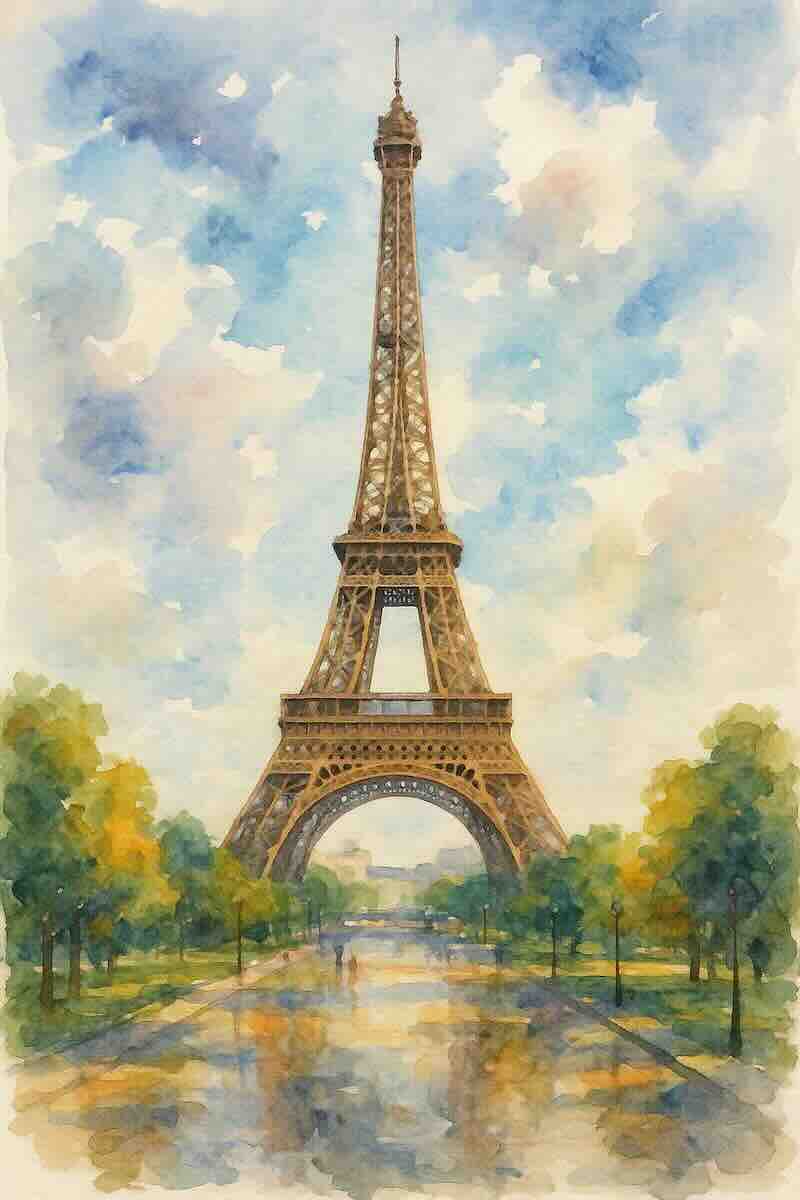
One famous place is the Eiffel Tower.
The Eiffel Tower is very tall.
The tower is big.
The tower is made of metal.
The tower is brown and grey.
The tower is in a park.
The tower is near a river.
The river is called the Seine.
People take photos of the tower.
Many people see the tower every day.
The tower has a name.
A man named Eiffel made the tower.
His name was Gustave Eiffel.
He was an engineer.
He liked buildings.
He wanted a tall tower.
He wanted the tower in Paris.
Many people said no.
Eiffel said yes.
Men worked on the tower.
They worked for two years.
The tower opened in 1889.
People came to see it.
People looked up.
Some people liked the tower.
Some people did not like it.
Now many people love it.
The Eiffel Tower has three floors.
You can walk up the tower.
You can ride up the tower.
You can see Paris from the top.
The view is very nice.
At night, the tower has lights.
The lights are very bright.
The tower is beautiful at night.
The Eiffel Tower is a symbol of Paris.
It is on shirts and bags.
People take selfies there.
Many people visit every year.
Children like the tower.
The Eiffel Tower is for everyone.
Level 1 Reader
570 Words
A Big Tower in Paris
Paris is a big city. It is in France. Many people visit Paris. Paris has many famous places. One famous place is the Eiffel Tower. The Eiffel Tower is very tall. It is made of metal. It looks like a triangle. It is brown and grey. It stands in a park. The Eiffel Tower is next to the River Seine. People take photos of the tower. Many people go to see it every day.
A Man Named Eiffel
The tower is named after a man. His name was Gustave Eiffel. He was an engineer. He made bridges and buildings. Gustave Eiffel had an idea. He wanted to build a tall tower. He wanted the tower in Paris. Many people said, “No, it is too strange!” But Eiffel said, “Let me try.” In 1887, work began. Many men worked on the tower. They used metal and big tools. It took two years to build the tower.
The Tower is Ready
The Eiffel Tower opened in 1889. It was for a big fair. The fair was called the World’s Fair. The tower was the tallest building in the world. It was 300 meters tall. People came from many countries. They looked up and said, “Wow!” But not everyone liked it. Some people said, “It is ugly.” Other people said, “It is beautiful.” Now, most people love it.
Climbing the Tower
The Eiffel Tower has three floors. There are stairs and elevators. You can walk up or ride up. The first floor has a glass floor. You can look down. You can see the people and cars below. The second floor has shops. You can eat food there. You can buy gifts. The top floor is very high. It is cold and windy. But the view is amazing. You can see all of Paris.
Lights and Colors
At night, the Eiffel Tower has lights. It shines like stars. Every hour, the lights blink. People say, “It is like magic!” Sometimes the tower is a different color. On holidays, it can be blue, red, or green. At New Year, there are fireworks. The Eiffel Tower is the star of the show.
A Symbol of Paris
The Eiffel Tower is very famous. It is a symbol of Paris. It is on T-shirts, bags, and cups. Many movies show the Eiffel Tower. People kiss near the tower. People take selfies. Some people get married there. The Eiffel Tower is loved around the world.
Many Visitors
Every year, millions of people come. They wait in line. They buy tickets. They go up and take photos. Some people come in summer. It is hot, and the lines are long. Some people come in winter. It is cold, but it is quiet. There are guards and cameras. The Eiffel Tower is safe.
Fun Facts
The Eiffel Tower is made of iron. It is heavy. It has over 18,000 parts. It is painted every seven years. The tower can grow! When it is hot, the metal gets big. The tower can grow 15 centimeters. Birds sometimes sit on the tower. Sometimes it has snow. Sometimes it has fog.
A Tower for Everyone
Children like the Eiffel Tower. Parents like it too. Old people come. Young people come. Some people come once. Some people come many times. Some people say, “It is my dream.” The Eiffel Tower is for everyone. It is a place of joy.
Level 2 Reader
554 Words
A Symbol of Paris
The Eiffel Tower is one of the most famous landmarks in the world. It stands tall in Paris, France, and people from all over the world come to see it. When you think of Paris, you probably imagine the Eiffel Tower first. It is a symbol of France and its culture.
But did you know that many people did not like the tower when it was first built? Some thought it was ugly and didn’t belong in Paris. Today, however, millions of people visit it every year. It is now loved by both locals and tourists.
Who Built the Tower?
The Eiffel Tower is named after Gustave Eiffel, the engineer whose company built it. It was completed in 1889 for the World’s Fair, a big event that celebrated the 100th anniversary of the French Revolution.
Gustave Eiffel was already known for building bridges and iron structures. He didn’t design the tower himself, but he supported the idea and helped make it a reality. His company worked hard, using more than 18,000 pieces of iron to build the tower.
Building the Giant
Construction began in 1887 and took two years. It was finished just in time for the World’s Fair in 1889. At that time, it was the tallest building in the world, standing at 300 meters.
Building such a tall structure was not easy. Workers had to be very careful. Luckily, there were good safety measures, and only one person died during construction—very few for a project of that size at the time.
Many people were amazed by the tower. Others were shocked. Artists and writers signed a letter asking the city to remove it. They thought it ruined the beauty of Paris.
A Changing Purpose
The Eiffel Tower was only supposed to stand for 20 years. After that, it was going to be taken down. However, it became very useful as a radio tower. In fact, it helped the French military send messages during World War I.
Thanks to this new use, the tower stayed. Over time, people grew to love it more and more. It appeared in movies, books, and advertisements. It became part of Paris life.
Today, the tower is used for television and radio signals, but its most important job is tourism.
Visiting the Tower
Every year, over 6 million people visit the Eiffel Tower. It has three levels. You can take stairs or an elevator to reach the top. The view is amazing. On a clear day, you can see for more than 60 kilometers.
On the first and second floors, there are restaurants and gift shops. On the very top, there’s a small area where visitors can look out over the city. At night, the tower lights up. Every hour after sunset, it sparkles with thousands of lights for five minutes. It is a magical sight.
Fun Facts
Gustave Eiffel had a small apartment at the top of the tower. He used it to meet guests and do experiments.
The Eiffel Tower is painted every seven years to protect it from rust.
It can be different colors over time, but today it is a shade of bronze called “Eiffel Tower Brown.”
The tower can grow! In summer, the metal expands in the heat and makes the tower up to 15 cm taller.
Level 3 Reader
453 Words
The Eiffel Tower: A Symbol of Paris
Few landmarks are as instantly recognizable as the Eiffel Tower. Rising above the skyline of Paris, it has become a global icon of France, symbolizing both the elegance of French design and the boldness of modern engineering.
Designed by the engineer Gustave Eiffel, the tower was constructed for the 1889 Exposition Universelle (World’s Fair), which marked the 100th anniversary of the French Revolution. At the time, the structure was unlike anything the world had ever seen. Standing at over 300 meters tall, it was the tallest man-made structure in the world until the Chrysler Building was completed in New York City in 1930.
Despite its current popularity, the Eiffel Tower was not always loved. When it was first built, many Parisians hated it. Writers and artists called it “an iron monster” and “a disgrace to the city.” Some even signed a petition demanding it be torn down. Yet Gustave Eiffel defended his creation, arguing that it was a marvel of science and architecture. Over time, public opinion changed, and today, the tower is one of the most visited monuments in the world, attracting nearly seven million visitors annually.
Made of over 18,000 iron parts and held together by 2.5 million rivets, the Eiffel Tower was a technical achievement in its day. Construction took just over two years, and remarkably, only one worker died during the process—a record for that time. Its design was so advanced that engineers around the world studied it for decades, applying similar techniques to bridges and skyscrapers.
The tower has three levels that are open to the public. Visitors can climb the stairs or take elevators to enjoy stunning views of Paris. From the top, you can see famous landmarks such as the Seine River, Notre-Dame Cathedral, and the Arc de Triomphe. On clear days, the view stretches for over 70 kilometers.
More than just a tourist attraction, the Eiffel Tower has served practical purposes over the years. In the early 20th century, it was used for radio transmissions. During both World Wars, it played a role in military communications. Today, it still functions as a broadcasting tower and is illuminated every night with 20,000 sparkling lights.
Beyond its physical form, the Eiffel Tower has become a cultural symbol. It appears in countless films, paintings, and photographs, often representing love, beauty, or Paris itself. It’s also a favorite location for marriage proposals and romantic moments, reinforcing its reputation as the “Iron Lady” of Paris.
In a world where trends come and go, the Eiffel Tower has stood the test of time. From controversial beginnings to global admiration, it continues to inspire millions of people with its strength, grace, and enduring charm.
Extensive Listening
First Sentences
Level 1 Audio
Level 2 Audio
Level 3 Audio
Natural Overview 1
Natural Overview 2
Natural Discussion
Audio is AI-generated using
AWS Polly or Google NotebookLM
Check Your Understanding
Comprehension Activity
A) In the article or B) Not in the article.