
Level 1 Reader
1052 Words
The Star
One night, people all over the world saw something strange in the sky.
It was a star.
But it was not a normal star.
This star was very bright. It was brighter than the other stars. Some people said it looked like a white fire. Some people said it looked like a small sun.
People looked up and talked about it.
“What is that star?” they asked.
“Is it new?”
Many people did not know.
But some scientists watched the star very carefully.
One scientist lived in a small town. He had a telescope. Every night he looked at the sky through the telescope.
One night he saw the new star.
At first he felt excited.
“A new star!” he said.
But then he watched it again.
And again.
And again.
Soon he felt worried.
He made many notes. He wrote numbers on paper. He worked late into the night.
After many hours he stood up and said quietly,
“This star is moving.”
The star was not staying in one place.
It was moving through space.
And it was moving toward the Earth.
The scientist wrote letters to other scientists.
He told them about the star.
Soon many scientists around the world looked at the sky.
They used telescopes. They made calculations.
After some time they all understood the same thing.
The star was coming closer.
Closer to the Earth.
Some scientists felt afraid.
One old scientist spoke slowly to a group of people.
“The star is not only a star,” he said.
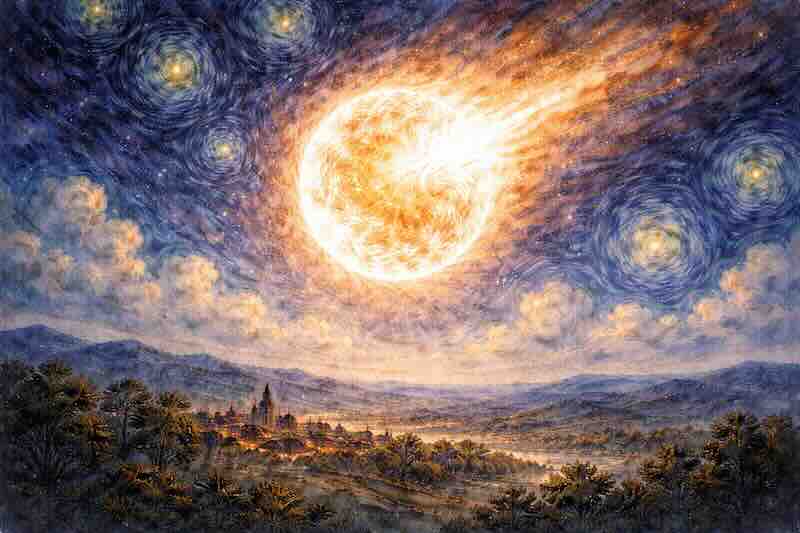
“It is a great burning world.”
He stopped and looked down.
“And it is coming near our world.”
But most people in the world did not know this.
They only saw the bright star.
They thought it was beautiful.
People stood in the streets at night and looked up.
Children pointed at the sky.
“Look!” they said.
“Look at the bright star!”
Some people laughed.
Some people made wishes.
Some people said the star was a sign.
In many cities people talked about it in cafés and restaurants.
Some people said it meant good luck.
Other people said it meant trouble.
But they did not know the truth.
Every night the star grew brighter.
Soon it was the brightest thing in the night sky.
It shone over mountains and oceans.
It shone over cities and farms.
Ships at sea saw the bright star above them.
Sailors watched it and talked about it.
“Have you ever seen a star like that?” one sailor asked.
“No,” said another sailor. “Never.”
The scientists continued their work.
They studied the sky day and night.
They checked their numbers again and again.
At last one scientist spoke to a group of reporters.
“The star will pass near the Earth,” he said.
“It will not hit the Earth. But it will come very close.”
The reporters wrote this in the newspapers.
Soon people all over the world read the news.
Many people did not believe it.
“Scientists worry too much,” they said.
But some people felt afraid.
As the star came closer, strange things began to happen.
The air became warmer.
Winter was not as cold as usual.
Snow melted early.
Rivers began to rise.
In some places the weather changed quickly.
There were strong winds and heavy rain.
In other places there was great heat.
Farmers looked at their fields and shook their heads.
“This is strange weather,” they said.
The star continued to grow.
It looked bigger every night.
Soon people could see it even in the daytime.
It was a white light in the blue sky.
People everywhere watched it.
Many people prayed.
Others stayed inside their homes and waited.
The scientists watched with great concern.
They knew the star was very powerful.
It was a huge world of fire moving through space.
Its gravity was strong.
It was pulling the Earth.
Then the oceans began to move.
At first the change was small.
But soon the water rose higher and higher.
Great waves moved across the seas.
Some waves crashed against the land.
Ships were thrown across the water.
In many places the sea came far onto the land.
Cities near the ocean were flooded.
People ran to higher ground.
They carried what they could.
But many things were lost.
The heat also grew stronger.
The air felt hot and heavy.
Ice melted in the far north and south.
Snow disappeared from many mountains.
Rivers grew larger and faster.
Storms became stronger.
The winds howled through towns and forests.
Trees fell.
Houses broke.
People tried to stay safe.
And still the star came closer.
It grew huge in the sky.
Now it looked like a burning world.
It shone with terrible light.
Even strong people felt afraid when they saw it.
“This is the end,” some people said.
Then came the closest moment.
The star passed near the Earth.
Very near.
The oceans rose into enormous waves.
Mountains shook.
The ground moved under people’s feet.
Cities fell.
Forests burned.
Great winds rushed around the world.
For many hours the Earth seemed full of chaos.
People cried out in fear.
Animals ran in every direction.
The sky was full of fire and cloud.
But slowly the star moved past the Earth.
Little by little it became smaller.
The terrible winds began to stop.
The oceans slowly returned to their places.
The storms grew weaker.
After many days the sky became calm again.
The Earth was very different now.
Many cities were gone.
Many lands had changed.
But the world was still alive.
High above the Earth, the star continued its journey through space.
It moved away from the Sun.
It became smaller and smaller in the sky.
Soon it looked like a normal star again.
And then one night people could not see it at all.
Far away in space, other planets moved quietly around the Sun.
On one small planet, astronomers watched the sky.
They saw the strange star pass near another world.
They wrote notes about it.
One astronomer spoke to his friend.
“That was interesting,” he said.
“Yes,” said the other astronomer.
“A star passed close to that little planet.”
They looked again through their telescopes.
“Life on that world must have had an exciting time,” he said.
Then they returned to their quiet work, watching the peaceful stars.
Level 2 Reader
1200 Words
The Star
One evening a strange new star appeared in the sky.
At first almost no one noticed it. The night sky was full of stars, and this one looked small and far away. People went home after work, ate dinner with their families, and prepared for sleep without thinking about it.
But one man did notice.
He was an astronomer. An astronomer is a scientist who studies the sky. Every night he looked through a telescope in a small observatory. His job was to watch the stars and planets and record their positions.
On that evening he saw something unusual.
There was a star where no star should be.
At first he thought he had made a mistake. Perhaps he had written the numbers incorrectly in his notes. Perhaps the telescope was not working properly.
He checked again.
Then he checked a third time.
The star was still there.
It was new.
The astronomer became very interested. He began to watch the star every night. Soon he noticed something else that worried him.
The star was moving.
At first the movement was very small. It was difficult to see unless you compared its position with the other stars. But each night it changed its place a little.
The astronomer made many careful measurements. Then he wrote letters to other astronomers in different countries.
“Please look at this star,” he wrote. “Tell me what you see.”
Soon many observatories around the world turned their telescopes toward the same place in the sky.
After several nights the scientists agreed.
The object in the sky was not an ordinary star.
It was a great burning world moving through space.
And it was coming closer.
At first only scientists knew this information. Ordinary people simply saw a bright new star in the evening sky.
In towns and cities people began to talk about it.
“Look at that star!” someone would say.
“It is very bright tonight.”
Children pointed to it with excitement. Couples walking home after dinner stopped to admire it. Some people said it was the most beautiful star they had ever seen.
Newspapers began to print short stories about it.
“A New Star in the Sky,” one newspaper wrote.
Scientists explained that it was an unusual discovery. Many readers found the story interesting but not important.
After all, stars were very far away.
How could a star affect life on Earth?
But the astronomers continued their work.
Every day they made new calculations. They measured the speed and direction of the strange object. As the days passed, their concern grew stronger.
The star was moving very quickly.
And its path was bringing it close to the Earth.
One evening a group of scientists met together to discuss the situation.
One older astronomer spoke slowly.
“The object is not truly a star,” he said. “It is a large world made of burning gas and rock. It has entered the Sun’s system, and it is traveling toward our planet.”
Another scientist asked an important question.
“Will it hit the Earth?”
The older astronomer shook his head.
“No. According to our calculations, it will pass near us. But it will come very close.”
He paused before speaking again.
“And its gravity may cause great problems.”
Soon the news reached the newspapers.
This time the headlines were much larger.
“A Star Approaches the Earth!” they announced.
Many people read these stories with curiosity. Some believed the scientists immediately. Others laughed and said it was impossible.
“How can a star come near the Earth?” they asked.
“It must be a mistake.”
But each night the star became brighter.
Within a few weeks everyone could see the change.
It was now the brightest object in the sky.
Even people who never watched the stars noticed it.
As the star came closer, strange things began to happen.
First the weather changed.
Winter that year was not very cold. Snow melted earlier than usual. Rivers began to rise before spring arrived.
Farmers looked at their fields and talked about the unusual warmth.
“This winter is strange,” they said.
Soon the changes became more serious.
The oceans began to behave differently. Tides became much higher than normal. Water covered beaches and flooded streets near the sea.
Ships sailing across the oceans reported enormous waves.
Even in calm weather the water moved violently.
Scientists understood the reason.
The powerful gravity of the approaching star was pulling at the Earth.
At the same time the air grew warmer.
Day after day the temperature increased. Ice began to melt in the far north and south. Snow disappeared from many mountains.
Rivers grew larger as huge amounts of water flowed toward the sea.
Then powerful storms appeared.
Strong winds rushed across the land. Lightning flashed across dark clouds. Heavy rain fell for hours or even days.
Trees broke and houses collapsed in the violent weather.
Now many people understood that something was terribly wrong.
The star continued to grow larger in the sky.
At night it shone with a strong white light. It was almost as bright as the moon. Sometimes people could even see it during the daytime, shining faintly in the blue sky.
When people looked at it through telescopes, they saw that its surface seemed to burn like fire.
Fear spread across the world.
Some people believed the end of the world was coming. Families gathered together and prayed. Others tried to travel far from the oceans, hoping to find safety on high land.
But many people continued their normal lives, hoping that the scientists had made a mistake.
Finally the day came when the star passed closest to the Earth.
On that day the world experienced terrible events.
The oceans rose into enormous waves. Water rushed across the land and destroyed many cities near the coast. Ships were thrown far inland.
Earthquakes shook the ground.
Mountains trembled.
Powerful winds moved across the continents, tearing down buildings and forests.
The sky became dark with clouds and storms.
For many hours people believed the world might end.
But slowly the star began to move away.
Little by little its powerful pull on the Earth became weaker.
The great waves returned to the oceans.
The winds grew calmer.
The storms slowly disappeared.
After many days the sky became peaceful again.
The Earth had changed greatly. Many towns had been destroyed. New rivers and lakes had formed. Forests had fallen or burned.
Yet the planet itself still survived.
Life continued.
As the weeks passed, the star became smaller in the sky.
Each night it looked farther away. Its bright light slowly faded.
Soon it appeared like an ordinary star again.
And finally one evening it disappeared completely from sight.
Far away in space, astronomers on another world had watched the entire event.
With powerful instruments they had observed the strange star passing close to the small blue planet called Earth.
One astronomer wrote a short note in his records.
“A wandering star passed near a small planet,” he said.
His colleague looked through the telescope and nodded calmly.
“I wonder if anything important happened there,” he said.
They thought about it for a moment.
Then they returned to their quiet work, studying the peaceful stars.
Level 3 Reader
1360 Words
The Star
At the beginning, very few people noticed the star.
It appeared suddenly in the sky, shining with a clear white light. At first it was only a small point among thousands of others, and most people paid little attention to it. But astronomers—people who studied the heavens—were not so careless. When they looked through their telescopes, they saw something strange.
The new star was not in the place where a star should be.
One evening an astronomer who worked alone in a quiet observatory noticed it while studying the planets. At first he believed it must be a mistake. Perhaps his telescope was not properly adjusted. Perhaps he had written something incorrectly in his notes. But after checking his observations again and again, he realized the truth.
A new object had appeared in space.
He immediately wrote to other astronomers in different countries. Soon observatories across the world turned their telescopes toward the same place in the sky. Within a few days there was no doubt about it.
A strange star had appeared where none had been before.
At first the discovery created excitement. New objects in space were rare, and scientists were eager to study it. They compared notes, measured its brightness, and carefully calculated its position.
But after a short time, excitement began to change into concern.
The star was moving.
Night after night it shifted slightly among the other stars. At first the movement was small and difficult to measure, but as the days passed the change became clearer. The astronomers soon realized that the object was not simply a distant star.
It was a world of fire rushing through space.
And it was coming toward the solar system.
At the beginning, ordinary people knew nothing about this danger. They simply noticed that a very bright star had appeared in the evening sky.
In cities and villages people stopped in the streets and looked upward.
“Have you seen the new star?” they asked each other.
“It is brighter every night.”
Children pointed at it with excitement. Lovers walking together after sunset admired its beauty. Even people who rarely thought about the sky found themselves staring upward in wonder.
Newspapers began to publish small articles about it. At first the reports were calm and scientific. They described the discovery and included drawings of the star’s path across the sky.
But the tone of the articles soon changed.
Scientists had completed their calculations.
The new star was not simply passing near the solar system.
It was moving toward the Earth.
Among the astronomers there was great concern. They met together and discussed their observations with serious expressions. Some of them spoke quietly, as if they were afraid of their own conclusions.
One of the oldest scientists explained the situation carefully.
“The object is not truly a star,” he said. “It is a massive planet or world of burning material. It has entered the gravitational field of the Sun, and its path is bringing it close to the Earth.”
Someone asked the most important question.
“Will it strike our planet?”
The old astronomer shook his head slowly.
“No. According to our calculations it will pass nearby. But ‘nearby’ in space may still mean a terrible distance for us.”
He paused before continuing.
“The danger comes from its gravity and its heat.”
Soon the news spread beyond the scientific community. Newspapers printed larger headlines. Some writers tried to explain the danger in simple language, but many people did not fully understand.
Some readers laughed and said the scientists were exaggerating.
Others became deeply frightened.
Preachers spoke about it in churches. Philosophers discussed it in universities. In cafés and public squares people argued about whether the world was truly in danger.
Yet most people continued their normal lives.
They went to work, cared for their families, and looked at the bright star each night before going to sleep.
Meanwhile the star continued its silent journey through space.
Every evening it appeared larger and brighter.
Within a few weeks it had become the most brilliant object in the sky. Its light shone even through thin clouds. Sometimes it appeared in the early morning before sunrise, glowing pale above the horizon.
Astronomers followed its progress with increasing anxiety.
Their instruments showed that it was growing closer very quickly.
And as it approached, strange changes began to occur on Earth.
At first the changes seemed small.
Winter was unusually warm that year. Snow melted earlier than expected, and rivers began to rise before spring had truly begun. Farmers noticed the difference but did not understand the reason.
Soon the changes became more dramatic.
The oceans began to move in unnatural ways. Tides grew higher than anyone had ever seen. In coastal towns the sea rose over the docks and flooded nearby streets.
Ships at sea reported enormous waves appearing suddenly in calm water.
The scientists understood what was happening.
The approaching star was pulling at the Earth with its powerful gravity.
The heat also increased.
Day after day the air felt warmer. In some places people welcomed the change, believing that spring had arrived early. But soon the warmth became uncomfortable and even dangerous.
Snow disappeared from mountain peaks.
Ice melted in the polar regions.
Rivers grew larger and faster as enormous quantities of water flowed toward the oceans.
At the same time storms began to appear across the world. Powerful winds swept across the land, destroying houses and forests. Lightning flashed constantly in dark clouds that seemed to cover half the sky.
Many people began to realize that something terrible was happening.
During the final weeks the star became an enormous object in the sky.
At night it shone with a fierce white light, brighter than the full moon. Even during the day people could see it clearly, glowing like a pale sun in the blue sky.
Its surface appeared to burn with moving fire.
The sight filled many people with fear.
Some believed the end of the world had come.
Families gathered together and prayed. Others traveled to high mountains, hoping to escape the rising oceans. Still others refused to believe any danger existed and continued their ordinary lives.
But the scientists knew that the most dangerous moment was approaching.
At last the star reached the nearest point of its journey.
On that day the Earth experienced chaos.
The oceans rose into enormous walls of water that rushed across the land. Entire cities near the coasts disappeared beneath the waves. Ships were thrown far inland as if they were small toys.
Earthquakes shook the continents.
Mountains trembled.
Forests collapsed in violent winds.
The sky darkened with thick clouds and storms of lightning.
For many hours the world seemed to be breaking apart.
Then, slowly, the star began to move away.
Its path carried it past the Earth and deeper into space. As the distance increased, the terrible forces that had shaken the planet began to weaken.
The winds gradually became calmer.
The great waves slowly returned to the oceans.
The storms moved away, leaving behind silence and destruction.
Many lands had changed forever.
Some cities had vanished beneath the sea. New lakes and rivers appeared where the ground had been torn apart. Vast forests had burned or been blown down by the storms.
But the Earth itself had survived.
In the following weeks the star continued to shrink in the sky.
Night after night it became smaller and dimmer as it traveled farther away from the Sun. Eventually it appeared once more like an ordinary star among thousands of others.
Then one evening it disappeared completely.
Far away in another part of the solar system, astronomers on a distant planet observed the event with great interest.
Through their powerful instruments they had watched the strange star pass close to the small blue world called Earth.
One of the astronomers made a note in his records.
“A remarkable astronomical event,” he said. “A wandering star passed very near a minor planet of the Sun.”
His colleague nodded calmly.
“I wonder whether anything important happened there.”
They considered the question for a moment.
Then they returned to their quiet observations of the peaceful sky.
Extensive Listening
Level 1 Audio
Level 2 Audio
Level 3 Audio
Natural Overview 1
Natural Overview 2
Natural Discussion
Audio is AI-generated using
AWS Polly or Google NotebookLM