

First Sentences
228 Words
The Statue of Liberty is a big statue.
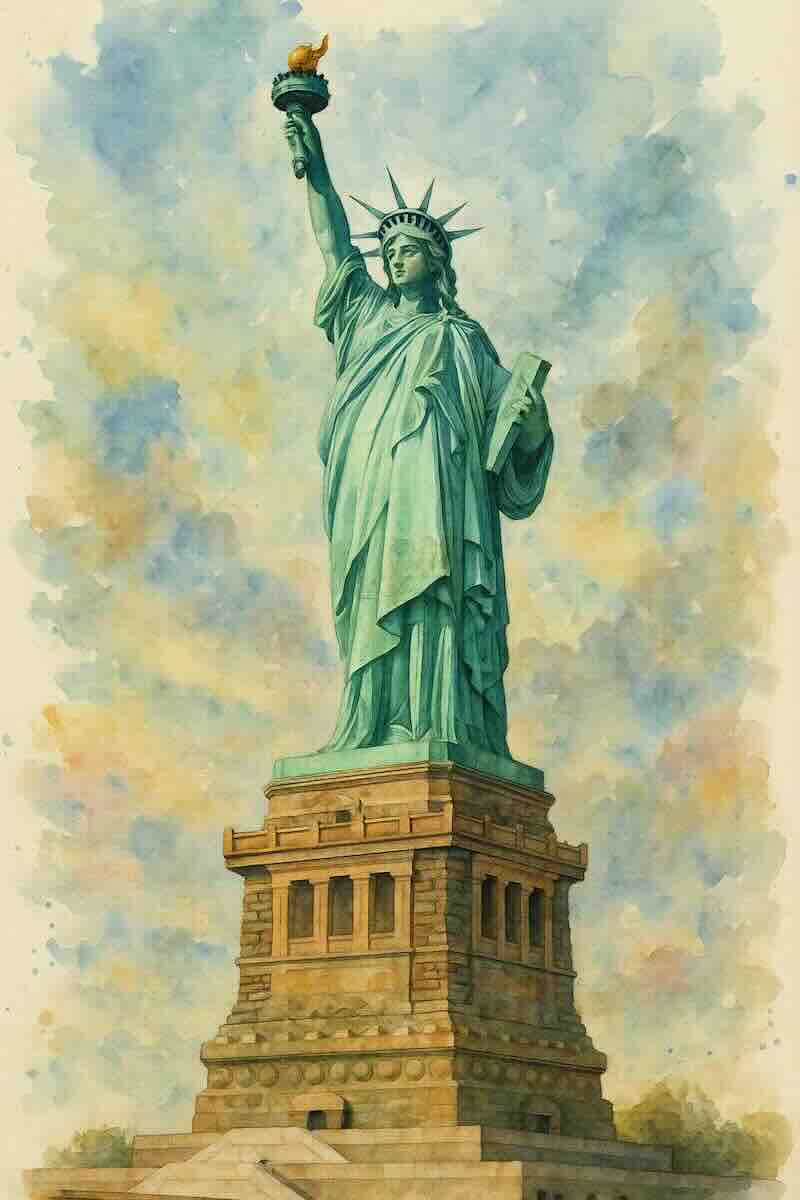
The statue is green.
The statue is very tall.
The statue is in New York.
New York is in the United States.
Many people know this statue.
Many people like this statue.
The statue looks like a woman.
She wears a long dress.
She has a crown on her head.
The crown has points.
She holds a torch.
The torch is in her right hand.
She holds a book.
The book is in her left hand.
The statue is a gift.
The gift came from France.
France gave the statue to the United States.
France and the United States are friends.
The statue came many years ago.
The statue came by boat.
It came in many pieces.
People put the pieces together.
People worked hard.
The statue means freedom.
Freedom is very important.
Long ago, people came by boat.
They came to America.
They wanted a new life.
They saw the statue.
They felt happy.
They felt hope.
The statue is very big.
You can go inside the statue.
You can walk up the stairs.
You can see the water.
You can see the city.
Today, many people visit the statue.
They take a boat to the island.
They take pictures.
They smile.
The statue is very old.
The statue is still strong.
The statue still stands.
The statue says, “Welcome.”
Level 1 Reader
450 Words
A Big Green Lady
The Statue of Liberty is a big, green statue. She stands in New York City, in the United States. She is very tall and very famous. Many people know her. The statue looks like a woman. She wears a long dress. She holds a torch in her right hand. She holds a book in her left hand. She has a crown on her head. The crown has seven points. The seven points are for the seven seas and seven continents.
A Gift from France
The Statue of Liberty came from France. France gave the statue to the United States. It was a gift. France and the United States are friends. France gave the statue in 1886. That was many years ago. French people made the statue. The statue came to the U.S. by boat. It came in many pieces. People in the U.S. put it together.
What She Means
The Statue of Liberty is not just a statue. She is a symbol. She means “freedom.” In the past, many people came to America by boat. They wanted a better life. They were poor. They were afraid. When they saw the statue, they felt happy. They were in a new country. They had hope.
Her Size
The statue is very big. She is over 90 meters tall with her base. Her finger is longer than your arm! Her nose is longer than your hand! You can walk inside the statue. You can take stairs to the crown. From the crown, you can see the water and the city. The view is very nice.
Visiting Today
Today, many people visit the Statue of Liberty. They come from all over the world. They take a boat to Liberty Island. They look at the statue. They take pictures. They smile. There is a museum too. People learn about the statue and her history. The Statue of Liberty is very old. But she is strong. She is still standing. She still says: “Welcome.”
Her Torch
The statue’s torch is very bright. It means “light” and “hope.” It says, “Come and find freedom.” The torch is gold in color. It shines in the sun. Long ago, it was a lighthouse. It helped boats at night. Today, it is not a real light. But it still shows the way.
She Is Special
The Statue of Liberty is on coins and stamps. She is in books, movies, and songs. She is a symbol of America. She is special to many people. She says: “You are free here.” “You can dream here.” “You can begin again.” The big green lady is more than a statue. She is a friend to the world.
Level 2 Reader
506 Words
A Gift from France
The Statue of Liberty is one of the most famous symbols of the United States. It stands on Liberty Island in New York Harbor and welcomes people arriving by sea. The statue was a gift from France to the United States in 1886. It was given to celebrate the 100th anniversary of American independence.
The French people wanted to show their friendship. They also believed in the same ideas as the Americans: freedom and democracy. A French sculptor named Frédéric Auguste Bartholdi designed the statue, and Gustave Eiffel, the man who later built the Eiffel Tower, helped with the structure inside.
Building the Statue
The Statue of Liberty was built in pieces in France. It took many years to finish. Each part was made of copper and shaped carefully. When all the parts were ready, they were sent to the United States by ship.
In New York, American workers built the base for the statue. Then, they put the statue together on top. The whole statue was completed and officially opened on October 28, 1886. There was a big celebration, and people were excited to see the new monument.
What She Looks Like
The Statue of Liberty is a woman wearing a long robe. She holds a torch high in her right hand. In her left arm, she carries a tablet. On the tablet, the date July 4, 1776 is written — the day the United States became independent.
She also wears a crown with seven points. These points represent the seven continents and the seven seas. It means liberty for all people around the world. At her feet, there are broken chains, which show freedom from slavery and oppression.
The statue is very large. From the base to the top of the torch, it is about 93 meters tall. People can climb 354 steps inside to reach the crown.
A Symbol of Hope
For many years, immigrants came to the United States by ship. The first thing they saw was the Statue of Liberty. To them, the statue was a sign of hope and a new life. It meant they had reached a land of freedom and opportunity.
Near the statue is Ellis Island. It was the place where immigrants were checked before entering the country. Between 1892 and 1954, more than 12 million people passed through Ellis Island. The Statue of Liberty became a symbol of their journey.
The Statue Today
Today, the Statue of Liberty is one of the most popular tourist attractions in the United States. People from all over the world come to visit. They can take a boat to Liberty Island and walk around the statue. Many visitors also go to the museum inside and learn about the history of the statue and the people who made it.
In 1984, the statue became a UNESCO World Heritage Site. It is protected as a cultural treasure. The statue is more than just a monument — it is a symbol of freedom, friendship, and the hope for a better future.
Level 3 Reader
570 Words
The Statue of Liberty: A Symbol of Freedom
When most people think of New York City, one image immediately comes to mind: the Statue of Liberty. Towering over Liberty Island in New York Harbor, she has become one of the most iconic symbols of freedom, democracy, and hope in the world. But how did this giant copper figure come to stand there, and what does she really mean?
A Gift from France
The Statue of Liberty was a gift from the people of France to the United States. It was meant to celebrate the centennial of American independence and to symbolize the strong friendship between the two countries. French sculptor Frédéric Auguste Bartholdi designed the statue, and Gustave Eiffel—the engineer who would later build the Eiffel Tower—helped with the internal metal framework.
Construction of the statue began in France in the early 1870s. Once completed, it was disassembled and shipped to New York in 1885 in over 300 separate pieces. It was then reassembled on a massive pedestal, which had been constructed on what was then called Bedloe’s Island.
A Grand Unveiling
On October 28, 1886, the Statue of Liberty was officially unveiled. The ceremony was grand, featuring speeches, parades, and naval salutes. President Grover Cleveland accepted the statue on behalf of the United States. From that day forward, Lady Liberty, as she came to be known, stood tall as a welcoming figure to immigrants arriving by sea.
What She Represents
The statue is rich in symbolism. Lady Liberty holds a torch in her right hand, representing enlightenment. In her left hand, she carries a tablet inscribed with the date July 4, 1776—the day the Declaration of Independence was signed. At her feet are broken chains, signifying the end of oppression and tyranny.
Her crown has seven spikes, which represent the seven continents and the seven seas, highlighting the universal concept of liberty. Although many people think of her as green, she was originally a shiny reddish-brown color. The greenish hue we see today is the result of natural oxidation of the copper surface over time.
A Beacon to Immigrants
Perhaps the most powerful aspect of the Statue of Liberty is the emotional response it inspires. For millions of immigrants arriving in America during the late 19th and early 20th centuries, she was the first thing they saw. Her image promised the possibility of a better life, where personal freedom and opportunity awaited.
At the base of the statue is a bronze plaque with the famous poem “The New Colossus” by Emma Lazarus. Its lines, “Give me your tired, your poor, / Your huddled masses yearning to breathe free,” became a powerful message of welcome and inclusion.
Preservation and Tourism
Over time, the statue suffered from weather and pollution, so several restoration projects have taken place. The most significant was for her centennial in 1986, when both the interior and exterior were repaired. Today, the Statue of Liberty is a major tourist attraction, drawing millions of visitors each year. Many climb the 354 steps to reach the crown, enjoying a panoramic view of New York City.
Conclusion
More than just a statue, Lady Liberty continues to stand as a powerful reminder of the ideals on which the United States was founded—freedom, hope, and the possibility of a better future. Whether viewed up close or from afar, her torch still shines brightly for people around the world.
Extensive Listening
First Sentences
Level 1 Audio
Level 2 Audio
Level 3 Audio
Natural Overview 1
Natural Overview 2
Natural Discussion
Audio is AI-generated using
AWS Polly or Google NotebookLM
Check Your Understanding
Comprehension Activity
A) In the article or B) Not in the article.